News · Research impact
Assoc. Prof. Sedat Arslan Named in World’s Top 2% Scientists 2026
Assoc. Prof. Sedat Arslan of Bursa Uludağ University ranked 774th worldwide in Nutrition & Dietetics, placing him in approximately the top 1.30% of researchers in the subfield in the 2025 single-year impact data.
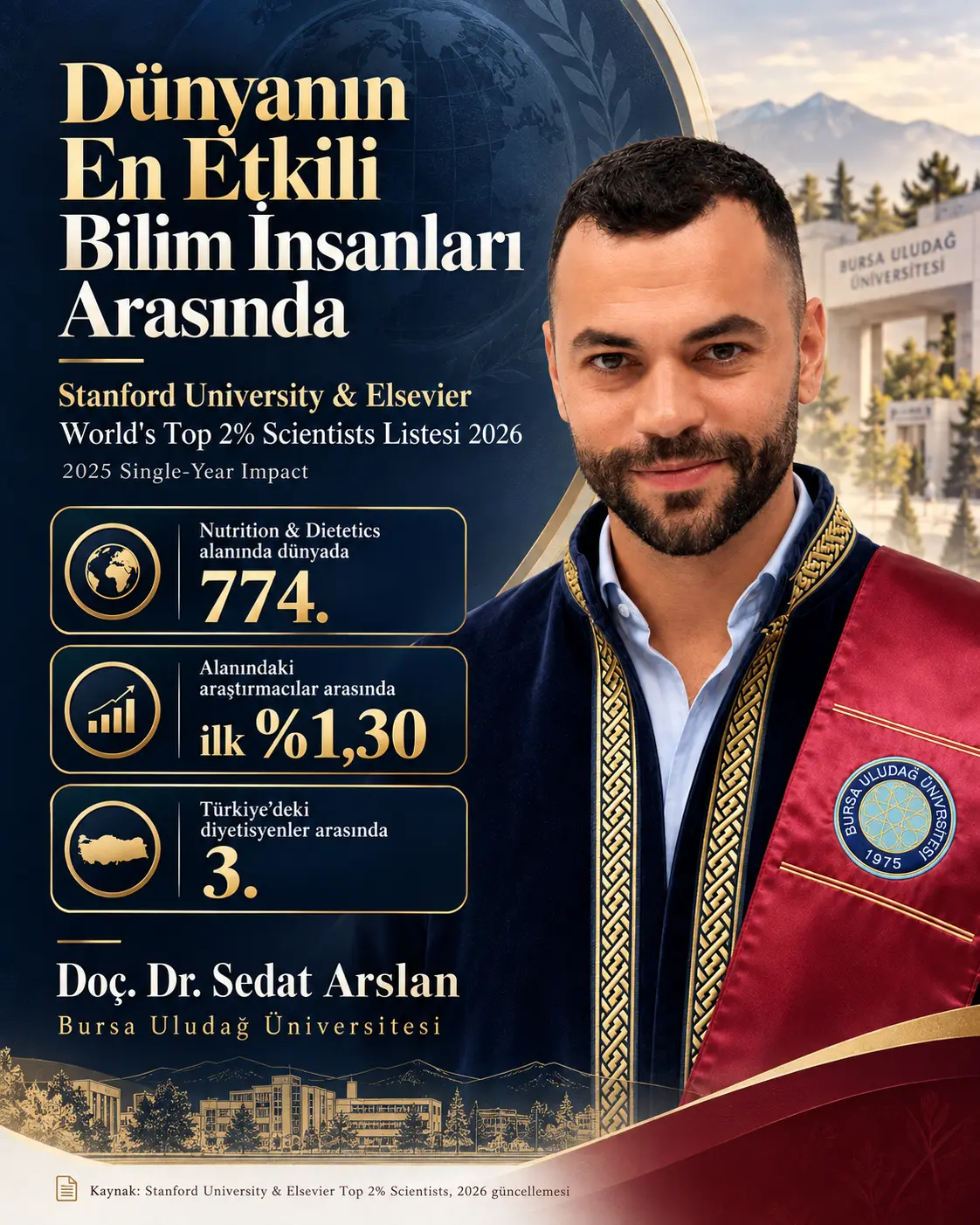
The 2026 update of the World’s Top 2% Scientists database, which compares international citation impact through field-standardised indicators, has been released. Arslan appears in the Nutrition & Dietetics subfield in the list covering citations received during the 2025 calendar year.
Ranked 774th worldwide in Nutrition & Dietetics
The data file reports Arslan’s subfield rank excluding self-citations as 774. Among the 59,506 researchers evaluated in Nutrition & Dietetics, this corresponds to approximately the top 1.30%. The ranking is based on a composite indicator of citation impact rather than publication volume alone and incorporates co-authorship and author position.
Türkiye has 1,776 researchers in the 2025 single-year list, including 26 affiliated with Bursa Uludağ University. A secondary review of the Turkish researchers classified under Nutrition & Dietetics places Arslan third among researchers with a professional background in dietetics. “Dietitian researchers” is not a separate category in the official database; this comparison is based on the professional backgrounds of the listed researchers.
What does the database measure?
Often described informally as “Stanford’s most influential scientists list,” this is not an award programme or a stand-alone distinction conferred by Stanford University. The bibliometric method was developed by Stanford researcher John P. A. Ioannidis and colleagues. The current dataset is published through the Elsevier Data Repository and is based on Scopus author profiles.
The assessment combines several indicators in a composite c-score: total citations, h-index, co-authorship-adjusted hm-index, and citations to single-authored papers and papers in which the researcher is first or last author. Metrics are reported both including and excluding self-citations. The 774th position reported here is the self-citation-excluded subfield rank.
Researchers are classified into 20 broad fields and 174 subfields using the Science-Metrix system. Inclusion is based on being among the top 100,000 scientists by composite score, with or without self-citations, or reaching at least the top 2% in a subfield. The field-based approach helps account for differences in publishing and citation practices across disciplines.
What does “2025 single-year impact” mean?
The update reports career-long and recent-year impact in separate files. The result discussed here comes from the 2025 single-year dataset and therefore reflects citations received during the 2025 calendar year. Calculations used Scopus author profiles in the 1 August 2026 snapshot. It is a standardised view of recent citation visibility rather than an overall ranking of an entire academic career.
The dataset’s publisher explicitly cautions that citation metrics have limitations. Bibliometric indicators illuminate one dimension of research impact; they do not fully capture research quality, education, societal contribution, or clinical value. The result is therefore best read as evidence of measured international citation impact in a defined period, not as an absolute judgment of scientific excellence.
A multidisciplinary research programme in nutrition
Assoc. Prof. Sedat Arslan is a faculty member and dietitian at Bursa Uludağ University’s Faculty of Health Sciences. His research spans clinical nutrition, obesity, malnutrition, food insecurity, eating behaviour, and the use of artificial intelligence in nutrition and digital health. This programme brings together clinical questions, population-level challenges, and emerging technologies through multidisciplinary collaborations.
Current information about his work is available through the research areas, academic profiles, and academic CV. Related news includes the academic achievement awards for nine Q1 publications in the first half of 2026.
Official data source
Ioannidis, J. P. A. (2026). August 2026 data-update for “Updated science-wide author databases of standardized citation indicators”, Elsevier Data Repository, Version 9.
View the Elsevier Data Repository record →Frequently asked questions
What is the World’s Top 2% Scientists database?
It is a public bibliometric database that uses Scopus data to compare standardised citation indicators across fields and subfields.
How was the 774th rank calculated?
It is the self-citation-excluded composite citation-impact rank within Nutrition & Dietetics, which contains 59,506 researchers.
What does the top 1.30% mean?
It is the approximate percentile obtained by comparing rank 774 with the 59,506 researchers in the same subfield.
Is this a Stanford award?
No. It is a bibliometric database based on a method developed by Stanford researchers and published through the Elsevier Data Repository, not an award programme.